Reduce • Shape • Flatten • Draw • Wind
Wire and rod rolling mills, grooved-roll systems and wire flattening machines for laboratory, development and specialty production applications.
Discuss Your Wire Or Rod Process →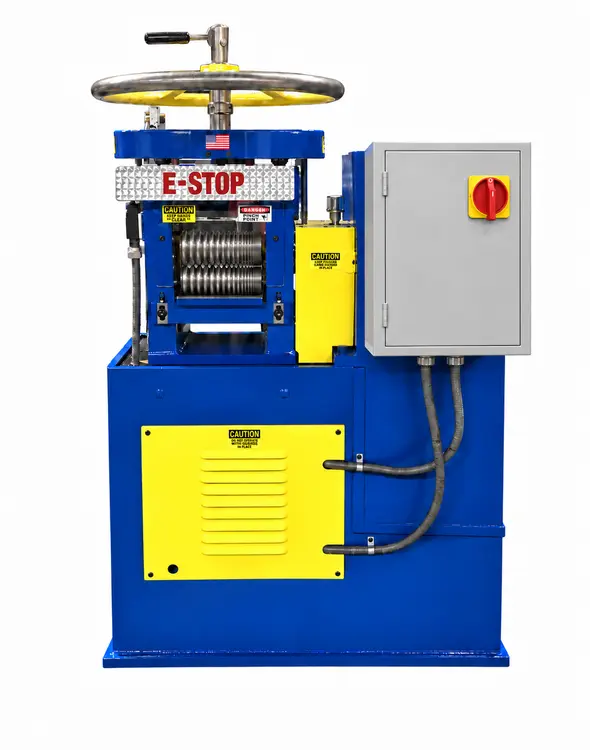
Browse available equipment below.
FROM STARTING STOCK TO FINISHED SECTION
International Rolling Mills supplies and refurbishes equipment for reducing, shaping, flattening, drawing and winding wire and rod. Our primary specialties include wire and rod rolling mills, grooved-roll systems and wire flattening machines.
We work with conventional alloys and high-value materials where roll profile, pass sequence and surface condition require particular attention.
Single-stand mills can be configured with flat or grooved rolls for round, square, shaped and specialty profiles. Multiple groove passes may be used for progressive reductions.
Groove dimensions describe the tooling, not a guaranteed final wire size. Actual dimensions depend on spread, fill, material condition, temperature and pass schedule.
Multiple rolling stands can be arranged in sequence for progressive reduction. Stand sizing, groove geometry, transfer speed and any interstand tension must be coordinated for the material and intended process.
Wire flattening mills convert round wire into flat ribbon or shaped strip. Applications include electronic materials, brazing alloys, spring stock, connectors and research samples.
Roll finish, alignment, tension and thickness control are important when processing narrow or high-value materials.
Drawing equipment pulls wire through a die to reduce and shape its cross-section. IRM can review bull blocks and available wire drawing machines against the alloy, starting size, finished section and operating requirements.
Wire Drawing Dies & Replacement Tooling →Traverse winders distribute wire or narrow strip across a spool or reel. Winding format, tension, speed and package dimensions should be coordinated with the upstream process.
Depending on availability and project scope, IRM can supply swagers, turkshead shaping equipment and related machinery, and review refurbishment or integration with existing equipment.
IRM helps universities, research laboratories and specialty producers evaluate laboratory wire processing equipment for alloy development, process trials and small batches. The equipment may combine rod rolling, wire flattening, lab-scale wire drawing and winding, selected around the starting stock and the required finished wire.
For specialty-alloy wire development, review the reduction sequence, material condition, dies or roll grooves, lubrication and intermediate annealing. Small-scale wire production also needs a practical way to handle limited sample lengths and collect the finished material.
A suitable bull block supports individual drawing passes, while other wire drawing arrangements may suit multi-pass or straight-length work. Laboratory wire drawing and pilot-scale requirements should be reviewed against available pull, speed, sample quantity and the measurements needed for the project.
Laboratory & Small-Batch Bull Block Drawing → | Wire Drawing Machines For R&D →
Developing a specialty alloy for wire-fed additive manufacturing can begin with a small cast rod rather than commercially available welding wire. IRM can help researchers and specialty producers evaluate the equipment and processing sequence for turning that starting material into wire for wire arc additive manufacturing (WAAM) or other wire-fed directed energy deposition (DED) systems.
Identify the alloy, cast-rod dimensions and incoming condition. Establish any heat treatment, surface preparation or conditioning needed before reduction.
Use a grooved rod mill to progressively reduce the rod toward a smaller wire section near the intended welding-wire size, where the alloy and roll package permit. Plan the final rolled section around the next drawing operation.
A suitable bull block or wire drawing machine pulls the reduced stock through a sequence of dies to reach the specified diameter and round section. Final sizing may require multiple passes and intermediate annealing.
The rolling and drawing split depends on the material’s workability, starting geometry, available equipment and final wire specification. For experimental alloys, trials help establish reductions, heating or annealing steps, lubrication and die selection.
Share the required wire diameter, tolerance, roundness, surface condition, spool format and intended AM system. Chemistry, cleanliness and feeding behavior also need to meet the application requirements; producing wire to size is one part of qualifying a feedstock.
Rod Rolling Mills → | Bull Block Drawing → | Discuss Feedstock Process Development →
IRM offers new equipment in selected product families, rebuilt machinery and used equipment. Options can include replacement rolls, groove packages, new drives and controls, speed feedback, instrumentation and coordinated handling equipment.
Equipment Refurbishment & Upgrades →Send the material, input form and diameter, desired output section, tolerance requirements, number of reductions, operating temperature and intended production rate. We can discuss appropriate machine types and available stock.
Request A Wire & Rod Equipment Quote →We use cookies to improve your experience. Privacy Policy.