FLAT WIRE • RIBBON • SPECIALTY METALS
Wire flattening mills reduce wire thickness between rotating rolls to produce flat wire and narrow ribbon. IRM supplies new, refurbished and used equipment for laboratory work, process development and specialty production.
Select the mill around your alloy, incoming wire size, finished section and winding requirements. Browse available machines below or talk with us about a custom configuration.
Discuss Your Flat-Wire Application →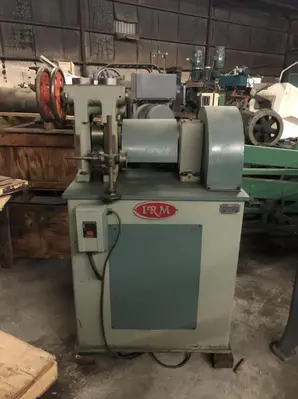
Choosing A Wire Flattening Mill
Start with the incoming wire and the required thickness, width, edge shape and surface finish. The machine configuration and pass schedule need to address the complete section.
A single rolling stand provides a compact starting point for development work and applications suited to one stand or repeated passes. Review the required reduction, roll size, available force and drive torque together.
Successive stands divide the forming operation into stages. Coordinated roll speeds, material guidance and tension between stands are important when planning a continuous line.
A 2-high mill uses two working rolls. A 4-high arrangement supports smaller work rolls with larger backup rolls; the smaller work-roll diameter can reduce the force required for a comparable reduction. Roll opening, drive arrangement and material requirements guide the choice.
Flattening round wire produces lateral spread as well as a reduction in thickness. A flat-roll stand alone does not independently set every aspect of the finished section. Edging or shaping equipment may be needed for controlled width, edge radius or a rectangular profile.
Precision Comes From The Whole System
Consistent flat wire depends on more than the indicated roll gap. Roll condition, alignment, incoming material and the way the wire moves through the line all matter.
Explore Precision Roll Grinding →Concentricity from one roll journal through the working face to the opposite journal, matched roll diameters where equal surface speeds are required, surface finish and roll parallelism deserve close attention. IRM can review roll refurbishment or replacement as part of the project.
Roll-position indication provides a setup reference; finished wire thickness and width still need appropriate measurement. Load cells, torque sensors and data acquisition can be reviewed where compatible with the mill and project requirements.
Payoff and take-up arrangements should suit the wire, spool size and process. Guides, speed coordination and appropriate tension control help the material track through the rolls and wind in a controlled package.
Alloy, temper, incoming size variation and the amount of reduction affect rolling behavior. Review intermediate processing and measurement needs when defining the route to the finished wire.
New • Refurbished • Customer-Owned
IRM builds custom equipment and refurbishes wire flattening mills from its own inventory, machines sourced through its industry network, and customer-owned equipment. We can review mechanical condition, rolls, bearings, drives, controls and material handling together.
Our former sister company Metaltek produced clad-metal products, while Apollo Tubing sold precious-metal strip, wire, rod and tubing. This background, together with decades of hands-on material processing, informs our discussions about the product and the equipment needed to make it.
Compare Refurbishment & New Equipment →Our experience spans multiple mill brands, including legacy equipment. IRM maintains documentation and spare parts for many older machines and can usually manufacture unavailable replacement parts after reviewing the requirements.
Nearly 50 years in business and MDNA membership connect us with an extensive machinery-industry network. If a suitable mill is not listed, we can look for a starting platform or discuss a new build.
Explore Custom Equipment →Request A Wire Flattening Review
We use cookies to improve your experience. Privacy Policy.