SPECIALTY METALS • PILOT WORK • PRODUCTION APPLICATIONS
Coordinate heating, reduction and material handling around your alloy, stock size and operating cycle.
IRM supplies new, refurbished and used rolling equipment, with application review spanning the mill, furnace, drives and controls.
Discuss A Hot Rolling Process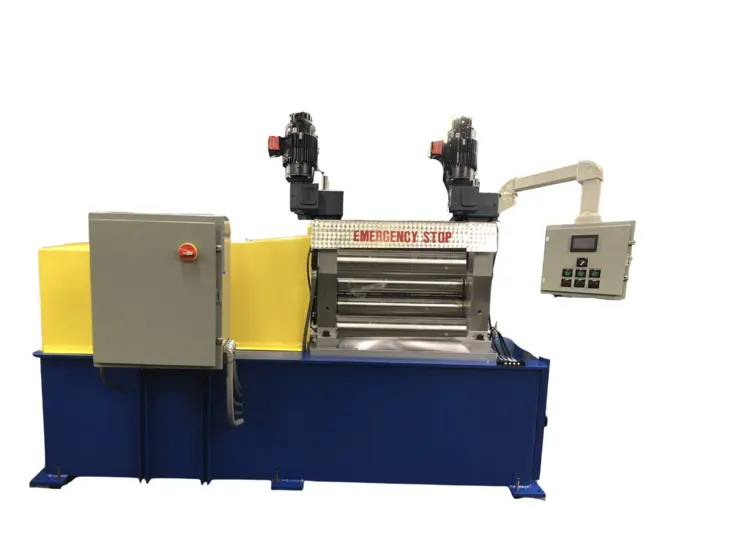
IRM Model 6030 heated 4-high mill. Process suitability and supplied configuration are confirmed for each application.
Planning specimen trials or an instrumented research mill? Explore Hot Laboratory Rolling Mills for laboratory heating arrangements and trial-data requirements.
01 / HEAT & TRANSFER
Define the material temperature required before each pass, the heating or soak time and the transfer route. Furnace settings alone do not establish the temperature of the stock as it enters the rolls.
02 / REDUCE
Evaluate the starting section, reduction per pass, roll diameter and face, available opening, drive torque and separating force. Heating can make some materials easier to reduce, but the required capacity remains alloy- and process-dependent.
03 / HANDLE & REPEAT
Plan feeding, exit support, reversing or return handling, reheating and unloading. For pilot or production work, the complete cycle determines practical output—not roll speed alone.
A preheating furnace can prepare the stock before rolling. An inline arrangement positions the furnace exit close to the roll nip, shortening transfer time and reducing carrying and repositioning of hot material. Chamber size, soak requirements, pass-line height and handling access must suit the stock and mill.
IRM can review furnace supply or integration with existing equipment. Heated entry tables may provide a compact alternative for suitable smaller specimens and lower-temperature processes.
Heated rolls can transfer heat during contact and can be preconditioned before receiving externally heated stock. The heating package, roll material, bearings and surrounding components must be suitable for the planned thermal conditions.
Hot, warm and cold processing are material-dependent regimes. A heated-roll option does not by itself establish suitability for every alloy or hot-working temperature.
Provide the expected hours of operation, batch sizes, time between passes and target output. Review heating capacity, drive duty, roll cooling or conditioning, lubrication and the feeding and collection arrangement together.
Compare 2-high, 4-high and combination layouts against your stock range. Supported smaller work rolls can lower the force needed for a comparable reduction, while roll opening and drive geometry may limit feed thickness. The installed roll package determines the usable setup.
Power screwdowns, variable-speed drives, force measurement and temperature monitoring can support setup and process observation. Specify the signals and records needed for operating control or process review. Roll position is not the same as finished-product thickness.
Review furnace access, hot surfaces, transfer tools, roll-nip guarding and emergency controls as one installation. Reducing hot-material handling can improve the transfer arrangement, but appropriate guarding, procedures and operator training remain necessary.
The IRM Model 6030 4-high work-roll-driven mill combines heated work rolls, power screwdowns and separating-force measurement. It illustrates one approach to controlled elevated-temperature processing; its listing and quotation define the equipment supplied, and suitability must be reviewed for your material.
Include alloy and material condition, incoming and finished dimensions, target material temperature, reduction per pass, batch size or throughput, duty cycle, existing furnace details and available utilities. Add atmosphere requirements and drawings of the proposed handling arrangement where relevant.
Discuss Your Hot Rolling Application401-722-7811We use cookies to improve your experience. Privacy Policy.