Grooved Rolls · Laboratory & Specialty Production
Reduce and shape metal through a planned sequence of grooved-roll passes. IRM supplies new, refurbished and used wire and rod rolling mills, with custom roll packages selected around your alloy, starting stock and finished section.
From laboratory trials to specialty production, we help match the mill, pass schedule and material handling to the process.
Discuss Your Wire Or Rod Application →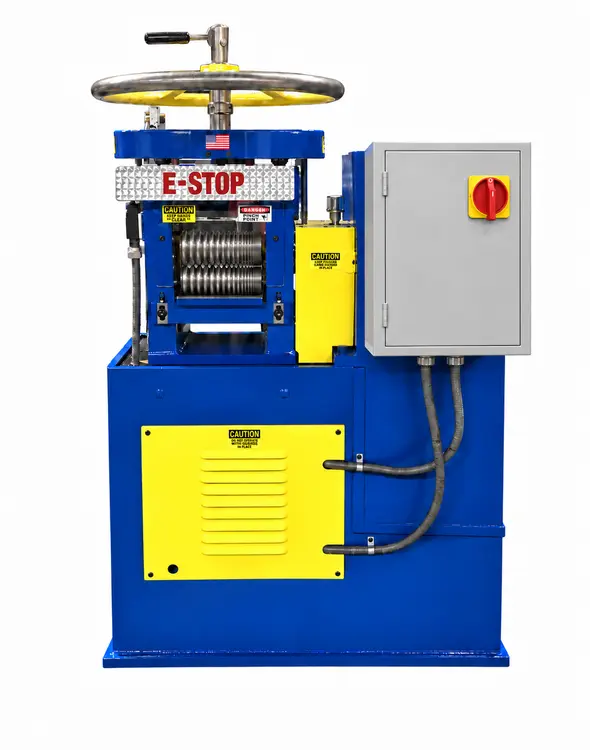
IRM 4258 laboratory wire and rod mill. Roll packages and supplied equipment vary by application.
A wire or rod mill is selected around the complete forming sequence, not just a nominal roll size. Round, square, oval, diamond and application-specific grooves can be combined in a pass schedule that progressively reduces the stock and develops its shape.
Groove fill, material spread and alignment between the upper and lower rolls all affect the result. Alloy, starting condition, rolling temperature and lubrication influence how much reduction is practical at each pass. A listed groove range alone does not establish the finished dimensions or tolerances a particular material will achieve.
A single-stand mill with multiple grooves can support trials across a range of starting sections and reductions. Operators move through the required passes, evaluating the material and adjusting the process as development progresses.
Discuss roll changes, groove access, adjustment, reversing requirements and data collection when specifying a research mill.
Explore Laboratory Rolling MillsA tandem arrangement places successive reductions in separate stands. Stand speeds, pass design, guides and material handling must be coordinated to suit the material flow and production rate.
Payoff, take-up and interstand handling requirements depend on whether the stock is processed as straight lengths or coil.
Explore Tandem Rolling MillsFor specialty-alloy and additive-manufacturing research, a customer may cast a small rod and use a grooved rod mill to reduce it progressively toward a smaller wire section. Where the material and roll package permit, rolling can bring the stock near the intended welding-wire size before final drawing.
The next stage uses a suitable bull block or wire drawing machine and dies to reach the required diameter and roundness for wire-fed AM, including WAAM and wire-fed DED. The last rolled section must suit the first drawing die; groove size alone is not a guarantee of finished wire diameter or roundness.
IRM can help review the cast-rod condition, groove sequence, reductions, hot or cold processing and intermediate annealing. For an experimental alloy, trials may be needed to establish a workable route from cast stock to draw-ready wire.
Bull Block Drawing For Final Sizing → | Explore The AM Wire Feedstock Route →
Grooved-roll mills use shaped passes to reduce rod or wire and develop the required section. The pass sequence may include intermediate shapes before reaching the final rolling pass.
Wire flattening converts wire into a flatter section. Thickness reduction, width spread, edge shape and the starting wire size become central selection factors. It is a different application from reducing rod through successive grooves.
Explore Wire Flattening MillsSome routes use rolling for initial reduction, followed by drawing through a die to approach the required size, shape or surface condition. There is no universal diameter at which rolling should give way to drawing.
Bull Block Drawing MachinesBegin with the alloy and condition, incoming dimensions and desired finished section. Define whether the process is cold, warm or hot, then review reduction per pass and whether intermediate heat treatment is needed.
For elevated-temperature trials, consider stock preheating, transfer time and roll temperature together. Heated rolls may be useful for selected applications; they do not replace a review of the stock-heating requirements.
Hot Laboratory Mill OptionsEntry and exit guides help present the material to the intended groove. Straight-length handling, coil payoff and take-up, and any downstream drawing operation should be considered before finalizing the layout.
Review operator access, roll-nip guarding, hot-stock handling where applicable, speed control and emergency-stop integration as part of the complete system.
Wire & Rod Processing EquipmentIRM builds new equipment and refurbishes suitable mills from our inventory, machines sourced through our industry network, and customer-owned equipment. We can review the rolls, bearings, adjustment mechanisms, drives and controls together. Custom groove arrangements and replacement roll packages should be reviewed against the machine's capacity, roll adjustment, drive and available space.
Share an existing pass schedule or sample drawing when available. If the process is still being developed, provide the starting and target sections so the mill and tooling requirements can be discussed together.
Custom Equipment Design · Equipment Refurbishment & Upgrades
Send the alloy and material condition, starting diameter or profile, finished section and tolerance, rolling temperature, required throughput, and whether the material will be drawn or coiled afterward.
Discuss Your Mill RequirementsWe use cookies to improve your experience. Privacy Policy.