

Standard Machinery 6-Stand Tandem Rod Rolling Mill
Tem um para vender?
DoençaNovo
1 disponível
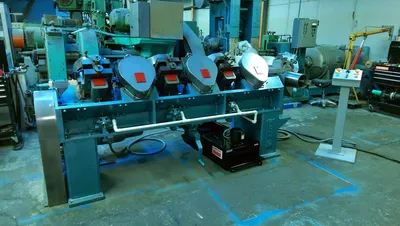
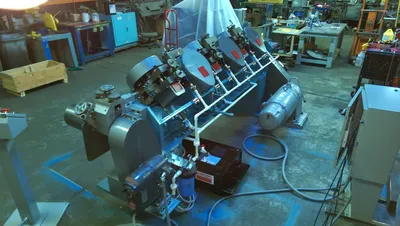
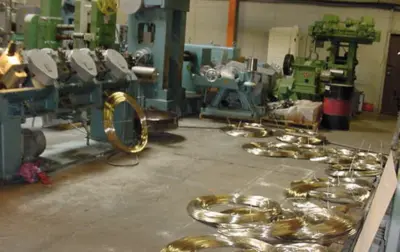
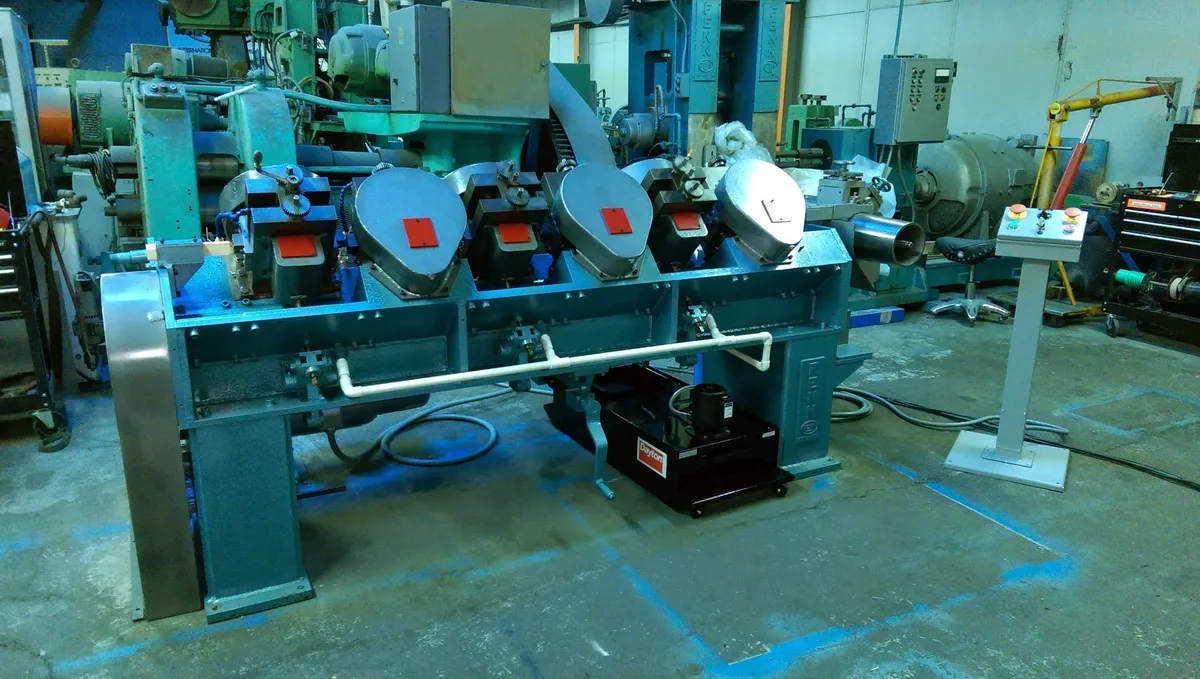
This Standard Machinery 6-Stand Tandem Rod Rolling Mill, a heavy-duty industrial production system designed for continuous, high-throughput reduction of rod and wire materials.
These units have long been used throughout the industry as robust, production-grade rolling mills, engineered for consistent multi-pass reduction within a defined size range. This machine is ideally suited for applications requiring repeatability, durability, and sustained production performance.
This 6-stand tandem mill is configured with approximately 4" diameter × 2" face width rolls, each containing three modified square grooves, allowing for a total of 18 progressive reductions (6 reductions per pass over three passes). Typical reduction schedules fall in the range of ~12–18% per pass, depending on material and final groove geometry.
The system is designed to process material from approximately ~0.400" (10 mm) round input down to ~0.120"–0.100" final size, subject to final roll inspection and regrinding during refurbishment.
A key feature of this machine is its centralized drive system, utilizing a single main motor to drive a common shaft and gear train. Each stand is powered through its own gear set, with progressively increasing roll speeds from stand to stand to match material reduction. This mechanically synchronized design ensures stable and repeatable production, but is inherently configured around a fixed pass schedule and groove progression.
The machine is also equipped with a built-in capstan at the discharge end, along with a three-roll coil forming station located just upstream of the capstan, allowing for controlled coiling of the finished product directly off the mill. This integrated setup supports efficient downstream handling and makes the system well suited for continuous production environments.
Compared to single-stand rolling mills or single-pass wire drawing systems (such as bull blocks), a tandem rod mill offers significant advantages in process efficiency and throughput. By performing multiple controlled reductions in sequence within a single line, the machine reduces the need for repeated handling, intermediate processing, and multiple passes through separate equipment. This results in improved productivity, more consistent material flow, and better dimensional repeatability in production environments.
Usamos cookies para melhorar sua experiência. Política de Privacidade.