

IRM Model #8014 8" × 14" 2-High Differential Speed Heated Laboratory Rolling Mill
Have one to sell?
ConditionNew
1 available
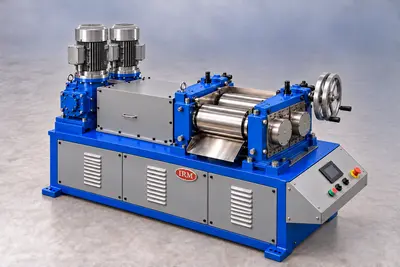
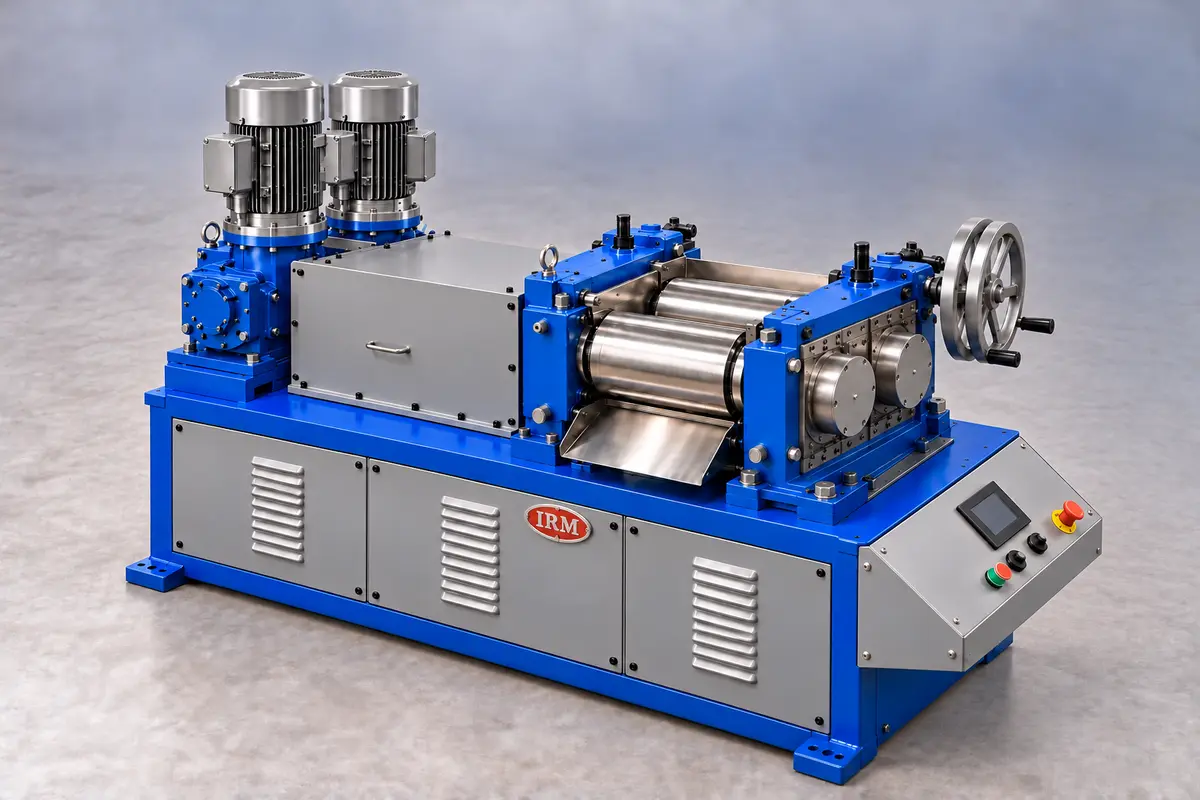
IRM Model #8014 8" x 14" 2-High Differential Speed Heated Laboratory Rolling Mill
MACHINE OVERVIEW
The IRM Model 8014 is a heavy-duty 2-High differential/asymmetrical laboratory rolling mill custom configured for the customer's application. It combines 8" diameter x 14" wide rolls, independent variable-speed drives, manual roll-gap adjustment, and internally heated rolls that transfer heat directly to the material during processing.
The quoted configuration is arranged for material to feed downward through the roll nip, with the roll assembly, material handling, and controls tailored to the customer's process requirements.
The combination of controlled roll speeds, independent roll heating, and mechanical gap adjustment allows the operator to establish operating conditions for individual trials and successive rolling passes. Additional instrumentation and recording options can be incorporated where required for the customer's research and process-development work.
MILL CONSTRUCTION & ROLL ASSEMBLY
The mill utilizes a heavy-duty industrial frame and housing assembly designed to maintain roll alignment and minimize unwanted movement and deflection under rolling loads. The rigid construction supports the roll assembly and helps maintain roll parallelism and roll-bite geometry during processing.
Precision bearing assemblies support the rolls, providing high radial load capacity and smooth rotation. The bearings, roll supports, and mill housings work together to maintain stable positioning of the rolls as material passes through the nip.
The 8" diameter x 14" wide rolls are manufactured from hardened high-carbon chromium alloy steel and precision ground with a satin finish. Both rolls have the same nominal diameter; differential operation is achieved through independent speed control.
ROLL ADJUSTMENT / SCREWDOWN
A dual handwheel screwdown assembly provides positive mechanical adjustment of the roll gap. The operator can establish the required opening for each pass and adjust roll parallelism to suit the sample and reduction schedule.
Independent adjustment at each end of the roll assembly allows the operator to make parallelism corrections in addition to changing the overall opening. The manual arrangement provides direct mechanical control during setup and between passes, supporting applications where roll settings are established around individual samples and trial conditions.
INDEPENDENT DRIVE SYSTEM & DIFFERENTIAL OPERATION
Each roll is independently driven by a dedicated 10 HP inverter-duty gearmotor with encoder feedback for closed-loop vector control. This arrangement supports controlled speed regulation as rolling loads change and allows each roll's speed to be set independently.
The current operating range is approximately 0–16 RPM per roll. Alternate speed ranges can be supplied to suit the application, with the drive configuration selected around the required rolling speed and operating conditions.
The rolls can operate at matched surface speeds for conventional rolling or at different surface speeds for differential/asymmetrical rolling. Variable speed relationships provide flexibility for studying shear deformation, friction, material bite, rolling force, texture development, and other process behavior.
The same roll geometry can therefore be used for both matched-speed and differential-speed trials, allowing the relative roll speeds to be varied as part of the experimental procedure.
HEATED ROLL PACKAGE
The included Heated Roll Package is intended to heat the material itself through contact with the roll surfaces during processing. Internal electric cartridge heaters provide roll heating, with roll-temperature capability up to approximately 450°F (232°C).
Each roll has its own dedicated temperature controller and thermocouple feedback for independent, closed-loop heating control. The operator can establish a separate temperature setpoint for each roll, allowing the two rolls to be operated at matched temperatures or different temperatures as required by the application.
The controllers regulate heater output to maintain their respective roll-temperature settings during operation. Heat transfers from the roll surfaces to the material as it passes through the nip, allowing heating and mechanical processing to occur together. Temperature settings can be selected in conjunction with roll speed, relative speed, and roll gap to suit the intended trial conditions.
The heated rolls can also be used to condition the roll assembly before processing externally heated material. Preheating helps reduce the temperature differential between the hot workpiece and roll surfaces, minimize thermal shock to the rolls, and maintain more stable thermal conditions during repeated hot-rolling passes.
CONTROLS & OPERATION
The mill is quoted for 480V, 3-phase power and includes a centralized operating station with a touchscreen HMI for mill operation and individual control of the two roll speeds.
The speed-control method will be configured to the customer's preference, such as individual speed setpoints for each roll or a single master speed setpoint with an adjustable ratio between the two rolls. This allows the operating sequence and speed-entry method to be matched to the customer's intended use.
The HMI will display each roll drive's VFD load and motor speed, giving the operator a live reference for both drives during setup and processing. Dedicated temperature controllers provide separate adjustment of each roll's heating settings at the operating station.
Optional instrumentation and data acquisition can be integrated with the controls for additional process monitoring and recording.
OPTIONAL FEATURES
Load Cell Package – Load cells provide real-time measurement of separating force for monitoring mill loading, comparing rolling passes, and evaluating process conditions. Force readings can be displayed through the operator interface and recorded through the optional data acquisition system, providing a reference for comparing changes in material, reduction, temperature, and relative roll speed.
Data Acquisition System – Selected process data can be recorded in CSV format to an SD card for review on the customer's computer. An additional-cost Ignition-based option records and stores data on the customer's server or network while retaining live display at the mill. Available parameters may include individual motor speeds, VFD loads, roll temperatures, timestamps, and separating force when load cells are fitted. The recorded signals depend on the instrumentation and communications included in the final configuration.
Spare Rolls, Tooling & Replacement Parts – Additional roll sets, specialized tooling, and recommended spare components can be supplied to support maintenance and future applications. Spare packages can be selected around anticipated use to simplify maintenance and reduce downtime. Alternate roll materials, finishes, profiles, and grooves can be evaluated where required, including compatibility with the heated-roll arrangement.
Additional System Integration – Further guides, sample feeding and collection arrangements, thickness gauging, guarding, automation, and integration with customer equipment or facility systems can be incorporated as required. Where applicable, added instrumentation can be integrated with the controls and data acquisition system for live monitoring and recording. Additional options should be specified at the time of order for inclusion in the custom machine design and controls.
PROCESS CAPABILITY
Actual rolling performance, achievable reductions, material temperature, finished gauge, dimensional consistency, surface condition, and throughput depend on the material and operating conditions. Relevant factors include material properties, starting dimensions, roll temperatures, roll gap, individual and relative roll speeds, contact time, reduction schedule, lubrication, feeding conditions, and roll condition.
Stated roll-temperature capability refers to the controlled temperature of the rolls and does not guarantee that the material will reach the same temperature during processing. Likewise, roll dimensions, motor ratings, and speed ranges do not by themselves establish achievable reductions, finished thickness, or production rate for a particular material.
Machine specifications describe the supplied equipment and its operating ranges; they do not constitute a guarantee of any particular material-processing result. Any specific process-performance guarantees or acceptance criteria must be expressly agreed in writing as part of the quotation or order acknowledgment.
FACTORY ACCEPTANCE TESTING & OPERATOR TRAINING
Factory Acceptance Testing (FAT) and operator training at IRM's facility are included. FAT demonstrates the functional operation of the supplied equipment as described in IRM's quotation before shipment, including the roll drives, controls, manual gap adjustment, and independent roll-heating systems.
FAT does not constitute a guarantee of material-processing outcomes, including achievable reductions, finished gauge, material temperature, surface condition, or throughput. Any process-specific performance guarantees or acceptance criteria must be expressly agreed in writing as part of the quotation or order acknowledgment.
Operator training familiarizes the customer's personnel with machine operation, the touchscreen HMI, roll-speed settings, manual gap adjustment, and independent roll-temperature controls. This allows the operators to review the custom configuration and its operating procedures with IRM before the machine is delivered.
SAFETY
IRM rolling mills are industrial metal-processing machines intended for operation by trained and qualified personnel. The Model 8014 is supplied with guarding and safety features appropriate to the specified configuration. Final safeguarding requirements may vary with the installation, material handling, and intended application.
The customer is responsible for ensuring that the completed installation and operation comply with applicable safety requirements and for providing any additional site- or application-specific safeguarding required for its use.
WARRANTY
New and IRM factory-refurbished equipment is supplied with IRM's standard one-year limited warranty, covering defects in materials and workmanship under normal use and service. See IRM's Standard Terms and Conditions for complete warranty terms, limitations, and exclusions.
REPRESENTATIVE IMAGES
Images are representative and may depict optional equipment or a different configuration. Actual appearance, guarding, controls, and accessories may vary with the final machine configuration.
IRM Model #8014 8" x 14" 2-High Differential Speed Heated Laboratory Rolling Mill
MACHINE OVERVIEW
The IRM Model 8014 is a heavy-duty 2-High differential/asymmetrical laboratory rolling mill custom configured for the customer's application. It combines 8" diameter x 14" wide rolls, independent variable-speed drives, manual roll-gap adjustment, and internally heated rolls that transfer heat directly to the material during processing.
The quoted configuration is arranged for material to feed downward through the roll nip, with the roll assembly, material handling, and controls tailored to the customer's process requirements.
The combination of controlled roll speeds, independent roll heating, and mechanical gap adjustment allows the operator to establish operating conditions for individual trials and successive rolling passes. Additional instrumentation and recording options can be incorporated where required for the customer's research and process-development work.
MILL CONSTRUCTION & ROLL ASSEMBLY
The mill utilizes a heavy-duty industrial frame and housing assembly designed to maintain roll alignment and minimize unwanted movement and deflection under rolling loads. The rigid construction supports the roll assembly and helps maintain roll parallelism and roll-bite geometry during processing.
Precision bearing assemblies support the rolls, providing high radial load capacity and smooth rotation. The bearings, roll supports, and mill housings work together to maintain stable positioning of the rolls as material passes through the nip.
The 8" diameter x 14" wide rolls are manufactured from hardened high-carbon chromium alloy steel and precision ground with a satin finish. Both rolls have the same nominal diameter; differential operation is achieved through independent speed control.
ROLL ADJUSTMENT / SCREWDOWN
A dual handwheel screwdown assembly provides positive mechanical adjustment of the roll gap. The operator can establish the required opening for each pass and adjust roll parallelism to suit the sample and reduction schedule.
Independent adjustment at each end of the roll assembly allows the operator to make parallelism corrections in addition to changing the overall opening. The manual arrangement provides direct mechanical control during setup and between passes, supporting applications where roll settings are established around individual samples and trial conditions.
INDEPENDENT DRIVE SYSTEM & DIFFERENTIAL OPERATION
Each roll is independently driven by a dedicated 10 HP inverter-duty gearmotor with encoder feedback for closed-loop vector control. This arrangement supports controlled speed regulation as rolling loads change and allows each roll's speed to be set independently.
The current operating range is approximately 0–16 RPM per roll. Alternate speed ranges can be supplied to suit the application, with the drive configuration selected around the required rolling speed and operating conditions.
The rolls can operate at matched surface speeds for conventional rolling or at different surface speeds for differential/asymmetrical rolling. Variable speed relationships provide flexibility for studying shear deformation, friction, material bite, rolling force, texture development, and other process behavior.
The same roll geometry can therefore be used for both matched-speed and differential-speed trials, allowing the relative roll speeds to be varied as part of the experimental procedure.
HEATED ROLL PACKAGE
The included Heated Roll Package is intended to heat the material itself through contact with the roll surfaces during processing. Internal electric cartridge heaters provide roll heating, with roll-temperature capability up to approximately 450°F (232°C).
Each roll has its own dedicated temperature controller and thermocouple feedback for independent, closed-loop heating control. The operator can establish a separate temperature setpoint for each roll, allowing the two rolls to be operated at matched temperatures or different temperatures as required by the application.
The controllers regulate heater output to maintain their respective roll-temperature settings during operation. Heat transfers from the roll surfaces to the material as it passes through the nip, allowing heating and mechanical processing to occur together. Temperature settings can be selected in conjunction with roll speed, relative speed, and roll gap to suit the intended trial conditions.
The heated rolls can also be used to condition the roll assembly before processing externally heated material. Preheating helps reduce the temperature differential between the hot workpiece and roll surfaces, minimize thermal shock to the rolls, and maintain more stable thermal conditions during repeated hot-rolling passes.
CONTROLS & OPERATION
The mill is quoted for 480V, 3-phase power and includes a centralized operating station with a touchscreen HMI for mill operation and individual control of the two roll speeds.
The speed-control method will be configured to the customer's preference, such as individual speed setpoints for each roll or a single master speed setpoint with an adjustable ratio between the two rolls. This allows the operating sequence and speed-entry method to be matched to the customer's intended use.
The HMI will display each roll drive's VFD load and motor speed, giving the operator a live reference for both drives during setup and processing. Dedicated temperature controllers provide separate adjustment of each roll's heating settings at the operating station.
Optional instrumentation and data acquisition can be integrated with the controls for additional process monitoring and recording.
OPTIONAL FEATURES
Load Cell Package – Load cells provide real-time measurement of separating force for monitoring mill loading, comparing rolling passes, and evaluating process conditions. Force readings can be displayed through the operator interface and recorded through the optional data acquisition system, providing a reference for comparing changes in material, reduction, temperature, and relative roll speed.
Data Acquisition System – Selected process data can be recorded in CSV format to an SD card for review on the customer's computer. An additional-cost Ignition-based option records and stores data on the customer's server or network while retaining live display at the mill. Available parameters may include individual motor speeds, VFD loads, roll temperatures, timestamps, and separating force when load cells are fitted. The recorded signals depend on the instrumentation and communications included in the final configuration.
Spare Rolls, Tooling & Replacement Parts – Additional roll sets, specialized tooling, and recommended spare components can be supplied to support maintenance and future applications. Spare packages can be selected around anticipated use to simplify maintenance and reduce downtime. Alternate roll materials, finishes, profiles, and grooves can be evaluated where required, including compatibility with the heated-roll arrangement.
Additional System Integration – Further guides, sample feeding and collection arrangements, thickness gauging, guarding, automation, and integration with customer equipment or facility systems can be incorporated as required. Where applicable, added instrumentation can be integrated with the controls and data acquisition system for live monitoring and recording. Additional options should be specified at the time of order for inclusion in the custom machine design and controls.
PROCESS CAPABILITY
Actual rolling performance, achievable reductions, material temperature, finished gauge, dimensional consistency, surface condition, and throughput depend on the material and operating conditions. Relevant factors include material properties, starting dimensions, roll temperatures, roll gap, individual and relative roll speeds, contact time, reduction schedule, lubrication, feeding conditions, and roll condition.
Stated roll-temperature capability refers to the controlled temperature of the rolls and does not guarantee that the material will reach the same temperature during processing. Likewise, roll dimensions, motor ratings, and speed ranges do not by themselves establish achievable reductions, finished thickness, or production rate for a particular material.
Machine specifications describe the supplied equipment and its operating ranges; they do not constitute a guarantee of any particular material-processing result. Any specific process-performance guarantees or acceptance criteria must be expressly agreed in writing as part of the quotation or order acknowledgment.
FACTORY ACCEPTANCE TESTING & OPERATOR TRAINING
Factory Acceptance Testing (FAT) and operator training at IRM's facility are included. FAT demonstrates the functional operation of the supplied equipment as described in IRM's quotation before shipment, including the roll drives, controls, manual gap adjustment, and independent roll-heating systems.
FAT does not constitute a guarantee of material-processing outcomes, including achievable reductions, finished gauge, material temperature, surface condition, or throughput. Any process-specific performance guarantees or acceptance criteria must be expressly agreed in writing as part of the quotation or order acknowledgment.
Operator training familiarizes the customer's personnel with machine operation, the touchscreen HMI, roll-speed settings, manual gap adjustment, and independent roll-temperature controls. This allows the operators to review the custom configuration and its operating procedures with IRM before the machine is delivered.
SAFETY
IRM rolling mills are industrial metal-processing machines intended for operation by trained and qualified personnel. The Model 8014 is supplied with guarding and safety features appropriate to the specified configuration. Final safeguarding requirements may vary with the installation, material handling, and intended application.
The customer is responsible for ensuring that the completed installation and operation comply with applicable safety requirements and for providing any additional site- or application-specific safeguarding required for its use.
WARRANTY
New and IRM factory-refurbished equipment is supplied with IRM's standard one-year limited warranty, covering defects in materials and workmanship under normal use and service. See IRM's Standard Terms and Conditions for complete warranty terms, limitations, and exclusions.
REPRESENTATIVE IMAGES
Images are representative and may depict optional equipment or a different configuration. Actual appearance, guarding, controls, and accessories may vary with the final machine configuration.
Imperial
| Roll Diameter | 8" |
| Roll Width | 14" |
| Roll Finish | Satin Finish |
| Roll Material | High Carbon Chromium Alloy Steel |
| Roll Gap Adjustment | Dual handwheels can allow for simultaneous or independent roll gap adjustment. |
| Mill Power | Two New 10 HP Inverter Duty AC Gearmotors |
| Mill Voltage | 480V |
| Mill Phase | 3-Phase |
| Mill Controls | New Variable Speed AC Inverters |
| Mill Safety | All nip points will be guarded. |
We use cookies to improve your experience. Privacy Policy.