IRM Model #8010 8" x 10" Hot Laboratory Rolling Mill
Have one to sell?
ConditionNew
1 available
RM Model #8010 8" x 10" Hot Laboratory Rolling Mill
MACHINE OVERVIEW
The IRM Model #8010 8" x 10" Hot Laboratory Rolling Mill is a heavy-duty, highly configurable rolling mill platform for research and development, metallurgical studies, process development, pilot-scale work, and specialty production applications. Configured by International Rolling Mills (IRM) around the customer's intended process, the Model #8010 combines heavy-duty mill construction, precision roll support, electro-mechanical roll-gap control, variable-speed operation, and a broad range of heating, instrumentation, and material-handling capabilities.
In its standard configuration, the Model #8010 utilizes 8" diameter x 10" wide precision-ground rolls and provides approximately 250,000 lbs of separating-force capacity. The mill is typically powered by a 40 HP variable-speed AC drive, providing substantially greater rolling capability than typical light-duty laboratory and bench-top mills while retaining the control and flexibility required for research and process-development work.
The #8010 is a modular rolling platform rather than a single fixed roll configuration. Depending on the application, the mill can be configured for conventional 2-High rolling, 4-High rolling, or differential/asymmetrical rolling, together with heated rolls, heated material handling, process instrumentation, data acquisition, coil winding equipment, and other application-specific systems. Roll material and finish, roll arrangement, drive speed, electrical supply voltage, controls, instrumentation, heating, and material handling can be selected around the customer's process requirements.
The Model #8010 can be configured for both hot and cold rolling applications. For true hot-rolling applications involving repeated processing of material at elevated temperatures, IRM recommends the Heated Roll Package to preheat and control roll temperature, reduce the temperature differential between the heated workpiece and roll surface, minimize thermal shock, and provide a more stable thermal condition during rolling.
MILL CONSTRUCTION
The Model #8010 utilizes a heavy-duty industrial mill frame and housing assembly designed to maintain roll alignment and geometry under high separating loads. The robust frame provides the structural stiffness and stability required to support rolling loads of approximately 250,000 lbs while maintaining accurate positioning of the roll assembly.
The overall mill construction is designed to minimize unwanted movement and deflection under load, helping maintain roll parallelism, roll-bite geometry, and consistent reductions across the working face. This construction provides the rigidity required for demanding rolling applications while maintaining the precision and controllability expected of a laboratory, research, process-development, pilot-scale, and specialty production mill.
ROLL ASSEMBLY & BEARINGS
The Model #8010 is typically configured with 8" diameter x 10" wide precision-ground rolls selected around the requirements of the intended application. Roll material, hardness, surface finish, and other characteristics can be specified based on the material being processed, rolling temperature, required surface condition, and anticipated operating loads.
The rolls are precision ground to provide accurate roll geometry and a controlled working surface. Alternate roll materials, hardnesses, surface finishes, profiles, and specialized roll configurations can be supplied where required for specific rolling applications.
The rolls are supported by precision bearing assemblies selected to provide high radial load capacity while maintaining accurate roll positioning and smooth rotation under load. The bearing arrangement works together with the heavy-duty mill frame to maintain roll alignment and stability throughout the rolling process.
For true hot-rolling applications, the roll and bearing arrangement should be configured around the anticipated operating temperatures at the time of order. IRM recommends internally heated rolls for applications involving repeated contact with hot material, allowing the rolls to be preheated before rolling to reduce the temperature differential between the workpiece and roll surface and minimize thermal shock. Applications requiring higher roll temperatures may require alternate roll and bearing configurations based on the intended process.
ROLL ADJUSTMENT / SCREWDOWN
Roll gap is controlled through dual electro-mechanical screwdowns, providing powered adjustment of the roll opening for successive rolling passes. Each screwdown is driven by a dedicated motor through a heavy-duty precision gearbox, providing smooth, controlled adjustment and positive positioning of the roll assembly.
The screwdown drives incorporate variable-frequency drive control and encoder feedback for accurate and repeatable roll positioning. Digital height indicators are displayed on the touchscreen HMI, providing the operator with a convenient reference point for each side of the roll assembly. These digital position references allow established roll settings to be recorded and repeated during successive passes and rolling trials while also assisting with roll-parallelism adjustment.
The digital height values provide a repeatable reference for roll position and setup rather than a direct measurement of finished material thickness. The combination of powered precision screwdowns, heavy-duty gearboxes, encoder feedback, and digital position indication provides accurate and repeatable roll-gap control for research, process-development, and specialty rolling applications.
DRIVE SYSTEM
The Model #8010 is typically powered by a 40 HP inverter-duty AC gearmotor with variable-frequency drive control, providing smooth speed adjustment and the torque required for controlled rolling throughout the intended operating range.
The electrical supply voltage and rolling-speed range can be configured to customer requirements at the time of order, allowing the mill to be matched to the available facility power and intended process. Variable-speed operation allows rolling speed to be adjusted to suit the material, reduction schedule, temperature, and process requirements. Reduced rolling speeds can be particularly useful for laboratory trials, process development, elevated-temperature rolling, and applications requiring greater operator control through the roll bite.
The final drive ratio, speed range, electrical configuration, and related controls are selected based on the intended application. The combination of the main drive, heavy-duty mill construction, precision roll support, and approximately 250,000 lbs of available separating force provides the Model #8010 with the power and structural capability required for demanding hot and cold rolling applications.
Alternate drive arrangements are incorporated when the mill is configured for applications such as differential/asymmetrical rolling that require independent control of the upper and lower rolls.
CONTROLS & OPERATION
The Model #8010 is supplied with modern controls and a touchscreen HMI designed for straightforward and reliable machine operation. The HMI provides centralized operator control and monitoring of the main mill drive and dual electro-mechanical screwdowns.
Encoder feedback from the screwdown system provides digital height indication for each side of the roll assembly directly on the HMI, giving the operator convenient roll-position reference points for setup, parallelism adjustment, and repeatable pass schedules.
The mill can be supplied with entry and exit tables configured around the intended process to support material as it passes through the rolls and assist with controlled material handling during successive rolling passes.
The control system also provides a foundation for optional process instrumentation and data acquisition. When equipped accordingly, operating parameters such as roll position, speed, temperature, motor current, separating force, rolling torque, and other available process signals can be monitored and recorded for process development, analysis, and traceability.
AVAILABLE CONFIGURATIONS & OPTIONAL FEATURES
The Model #8010 is a modular rolling mill platform that can be configured by IRM around the requirements of the customer's application. Many of the configurations and features described below affect the mill's mechanical arrangement, drivetrain, roll assembly, controls, guarding, or supporting equipment and are therefore intended to be specified at the time of order rather than added as field upgrades after delivery.
IRM will work with the customer to establish the appropriate machine configuration based on material, starting and finished dimensions, rolling temperature, reduction requirements, process objectives, instrumentation, and material-handling requirements. Available configurations and features include:
Heated Roll Package – For applications involving true hot rolling or repeated processing of material at elevated temperatures, IRM recommends specifying the Heated Roll Package at the time of order. The rolls are internally heated using electric cartridge heaters with closed-loop temperature control and thermocouple feedback, allowing the roll assembly to be brought to and maintained at a controlled operating temperature before heated material enters the roll bite. Roll temperatures of up to approximately 450°F (232°C) can be provided in the standard heated configuration. Preheating the rolls helps reduce the temperature differential between the workpiece and roll surface, minimizing thermal shock to the rolls and helping maintain a more stable and consistent rolling temperature during processing. Material entering the roll bite can be at temperatures substantially above the controlled roll temperature; the rolls do not need to operate at the same temperature as the workpiece. Applications requiring roll temperatures above approximately 450°F can also be evaluated but may require alternate roll and bearing configurations and related thermal-design changes based on the required operating temperature and process.
Load Cell Package – High-capacity load cells can be integrated into the mill to provide real-time measurement of separating force during rolling. Rolling-force information provides a valuable reference for process development, pass-to-pass comparison, and monitoring of mill loading. Force measurements can also be incorporated into the optional data acquisition system for recording and analysis.
Data Acquisition System – IRM can provide a standard data acquisition system that displays available process parameters through the touchscreen HMI and records selected data in CSV format to an SD card for subsequent analysis. For more advanced facility integration, an Ignition-based system can be supplied to record process data directly to the customer's own server or network infrastructure. Available parameters may include separating force, rolling torque, roll position, roll speed, temperature, motor current, timestamps, and other signals available through the control system.
4-High Rolling Configuration – The Model #8010 can be configured for 4-High operation utilizing smaller-diameter precision work rolls supported by larger backup rolls. The smaller work-roll diameter reduces roll-bite contact area and can reduce the rolling force required for a given reduction, expanding the mill's capability for thin-gauge rolling and applications where smaller work-roll geometry is advantageous. The complete 4-High configuration is engineered around the required work rolls, backup rolls, chocks, bearings, screwdown travel, and related mill components. Because these requirements affect the roll assembly and mill geometry, 4-High capability should normally be specified at the time of order.
Heated Entry Table – A temperature-controlled entry table can be supplied with operating temperatures of up to approximately 700°F (371°C) to preheat material and help maintain temperature immediately prior to rolling. This is particularly useful for warm rolling of lower-temperature alloys and other materials where maintaining a controlled temperature immediately before the roll bite is important. The system can incorporate an insulated, removable stainless-steel cover to create a controlled heating chamber and a material pusher for transferring heated samples directly into the rolls, helping provide more uniform preheating and minimize temperature loss between heating and rolling.
Differential / Asymmetrical Rolling Configuration – The Model #8010 can be configured at the time of order for differential or asymmetrical rolling using independently driven upper and lower rolls, allowing controlled differences in roll surface speed. This configuration incorporates the additional drive components, drivetrain arrangement, controls, and guarding required for independent roll operation while retaining the ability to operate the rolls at matched surface speeds for conventional rolling. Differential operation provides a versatile research platform for investigating rolling force, friction, material bite, shear deformation, texture development, and other specialized process behavior.
Coil Winding Equipment – Powered winding equipment can be integrated with the Model #8010 for continuous strip and foil rolling applications. The system can be configured for one-directional operation with a payoff and recoiler, or with powered forward and reversing winders positioned on both sides of the mill. The forward/reversing configuration is typically preferred for multi-pass rolling applications, allowing strip to be repeatedly rolled in either direction while maintaining controlled winding and material handling between passes.
Torque Measurement Package – Torque sensors can be incorporated into the mill drivetrain to provide real-time measurement of rolling torque during operation. When combined with roll speed, separating force, roll position, and other available process parameters, torque measurement provides additional insight into material behavior and the mechanical demands of the rolling process. Torque values can be displayed through the operator interface and incorporated into the optional data acquisition system for recording and analysis.
Spare Rolls, Tooling & Replacement Parts – Additional precision-ground roll sets, specialized tooling, and recommended spare or replacement components can be supplied with the mill. Spare packages can be configured around the intended application to reduce downtime, simplify changeovers, and provide critical components for future maintenance. Alternate roll materials, surface finishes, profiles, and grooves can also be supplied where required for specialized rolling applications.
Custom Engineering & System Integration – IRM can engineer additional equipment and functionality around the Model #8010 to meet application-specific requirements. This may include contact or non-contact thickness gauging systems, custom entry and exit material handling, guides, automated feeding or handling systems, specialized guarding, additional instrumentation and sensors, HMI and control functionality, automation, communications, integration with customer equipment or facility systems, and other mechanical, electrical, or control modifications. Where applicable, thickness measurement and other process instrumentation can also be integrated with the mill controls and optional data acquisition system for real-time monitoring and process recording. IRM can work with the customer to develop a complete rolling system around the requirements of the intended process.
These configurations and features can be selected individually or combined at the time of order to configure the Model #8010 from a straightforward heavy-duty rolling mill into a fully instrumented hot or cold rolling system with controlled heating, force and torque measurement, 4-High capability, differential/asymmetrical rolling, process data acquisition, integrated material handling, and coil winding equipment.
PROCESS CAPABILITY
The IRM Model #8010 is designed for controlled hot and cold rolling of a broad range of metallic materials for laboratory, R&D, metallurgical research, process-development, pilot-scale, and specialty production applications. Its combination of heavy-duty construction, 8" diameter x 10" wide rolls, approximately 250,000 lbs of available separating force, powered roll-gap adjustment, and variable-speed operation provides substantial rolling capability while retaining the flexibility required for experimental and developmental work.
For hot-rolling applications, the #8010 can be configured with internally heated rolls and complementary material-heating equipment to better control the thermal conditions surrounding the rolling process. Preheating the rolls is particularly important where hot material will be processed repeatedly, helping reduce thermal shock to the roll surface and provide a more stable temperature condition at the roll bite.
The modular design of the #8010 allows the machine to be configured around the intended rolling process at the time of order. Depending on the selected configuration, the platform can support heated rolling, 4-High thin-gauge rolling, differential/asymmetrical rolling, force and torque measurement, instrumented process development, thickness measurement, and coil-based forward/reversing operation. This flexibility makes the #8010 particularly useful for universities, research facilities, material developers, industrial laboratories, and specialty producers working with multiple materials or processes where rolling requirements may vary.
Actual rolling performance, reduction capability, finished gauge, surface condition, and dimensional results will vary based on material properties, starting geometry, temperature, reduction schedule, lubrication, roll condition, and other process variables. IRM can assist with machine selection, application evaluation, and material testing where appropriate to establish a suitable equipment configuration for the intended process.
SAFETY
IRM rolling mills are industrial metal-processing machines intended for operation by trained and qualified personnel. The Model #8010 is supplied with guarding and safety features appropriate to the specified machine configuration; however, final safeguarding requirements may vary based on the installation, material-handling arrangement, selected options, and intended application.
The customer is responsible for ensuring that the completed installation and operation comply with applicable safety requirements and for providing any additional site- or application-specific safeguarding required for its use.
WARRANTY
New and IRM factory-refurbished equipment is supplied with IRM's standard one-year limited warranty, covering defects in materials and workmanship under normal use and service. See IRM's Standard Terms and Conditions for complete warranty terms, limitations, and exclusions.
REPRESENTATIVE IMAGES
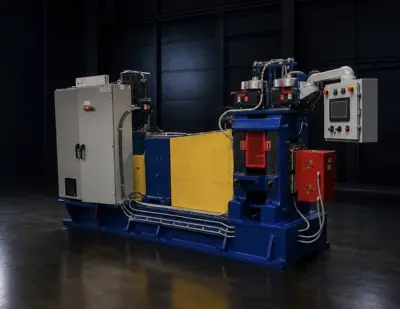
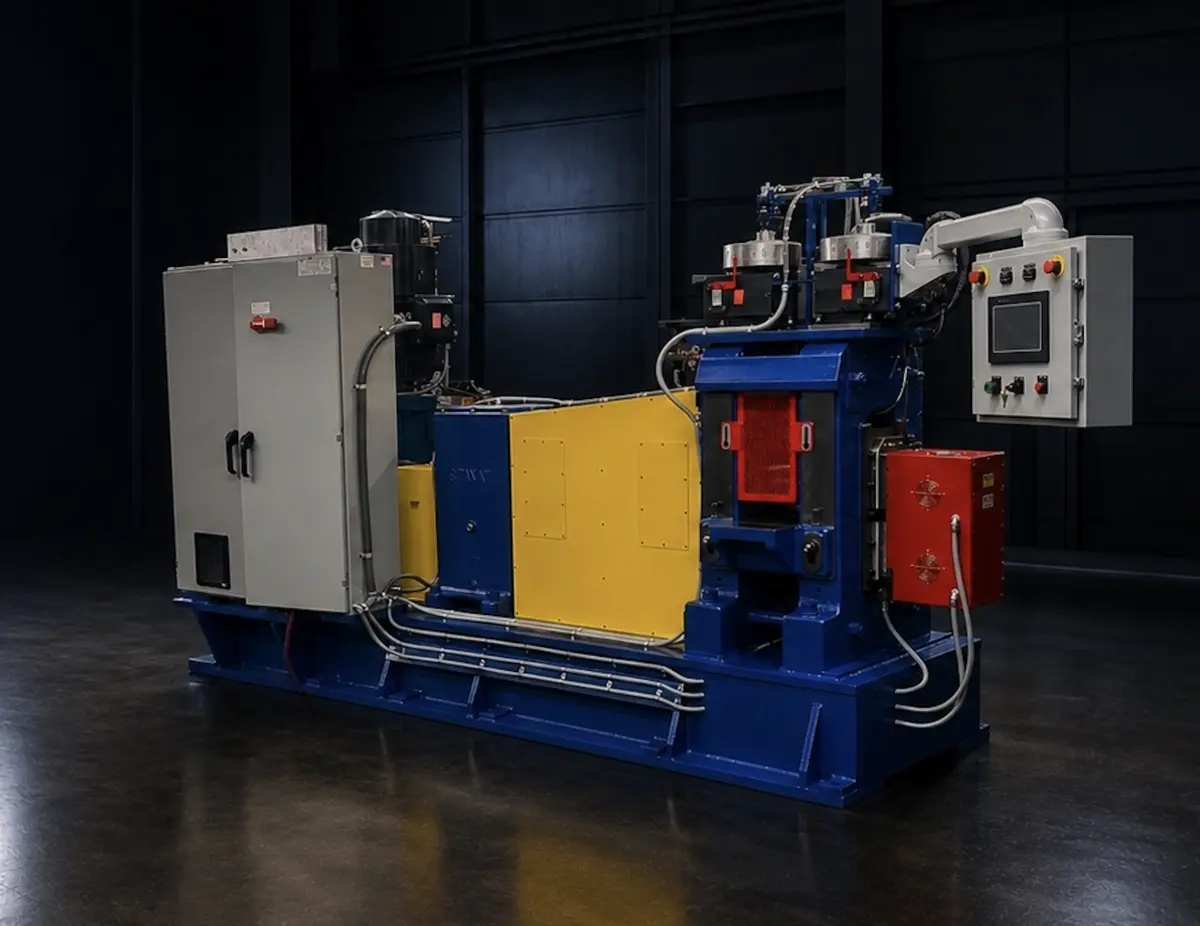
Images shown are representative of the machine and may depict optional equipment or a different configuration. Actual equipment may vary in appearance, guarding, controls, accessories, and other details based on the final machine configuration and selected options.
RM Model #8010 8" x 10" Hot Laboratory Rolling Mill
MACHINE OVERVIEW
The IRM Model #8010 8" x 10" Hot Laboratory Rolling Mill is a heavy-duty, highly configurable rolling mill platform for research and development, metallurgical studies, process development, pilot-scale work, and specialty production applications. Configured by International Rolling Mills (IRM) around the customer's intended process, the Model #8010 combines heavy-duty mill construction, precision roll support, electro-mechanical roll-gap control, variable-speed operation, and a broad range of heating, instrumentation, and material-handling capabilities.
In its standard configuration, the Model #8010 utilizes 8" diameter x 10" wide precision-ground rolls and provides approximately 250,000 lbs of separating-force capacity. The mill is typically powered by a 40 HP variable-speed AC drive, providing substantially greater rolling capability than typical light-duty laboratory and bench-top mills while retaining the control and flexibility required for research and process-development work.
The #8010 is a modular rolling platform rather than a single fixed roll configuration. Depending on the application, the mill can be configured for conventional 2-High rolling, 4-High rolling, or differential/asymmetrical rolling, together with heated rolls, heated material handling, process instrumentation, data acquisition, coil winding equipment, and other application-specific systems. Roll material and finish, roll arrangement, drive speed, electrical supply voltage, controls, instrumentation, heating, and material handling can be selected around the customer's process requirements.
The Model #8010 can be configured for both hot and cold rolling applications. For true hot-rolling applications involving repeated processing of material at elevated temperatures, IRM recommends the Heated Roll Package to preheat and control roll temperature, reduce the temperature differential between the heated workpiece and roll surface, minimize thermal shock, and provide a more stable thermal condition during rolling.
MILL CONSTRUCTION
The Model #8010 utilizes a heavy-duty industrial mill frame and housing assembly designed to maintain roll alignment and geometry under high separating loads. The robust frame provides the structural stiffness and stability required to support rolling loads of approximately 250,000 lbs while maintaining accurate positioning of the roll assembly.
The overall mill construction is designed to minimize unwanted movement and deflection under load, helping maintain roll parallelism, roll-bite geometry, and consistent reductions across the working face. This construction provides the rigidity required for demanding rolling applications while maintaining the precision and controllability expected of a laboratory, research, process-development, pilot-scale, and specialty production mill.
ROLL ASSEMBLY & BEARINGS
The Model #8010 is typically configured with 8" diameter x 10" wide precision-ground rolls selected around the requirements of the intended application. Roll material, hardness, surface finish, and other characteristics can be specified based on the material being processed, rolling temperature, required surface condition, and anticipated operating loads.
The rolls are precision ground to provide accurate roll geometry and a controlled working surface. Alternate roll materials, hardnesses, surface finishes, profiles, and specialized roll configurations can be supplied where required for specific rolling applications.
The rolls are supported by precision bearing assemblies selected to provide high radial load capacity while maintaining accurate roll positioning and smooth rotation under load. The bearing arrangement works together with the heavy-duty mill frame to maintain roll alignment and stability throughout the rolling process.
For true hot-rolling applications, the roll and bearing arrangement should be configured around the anticipated operating temperatures at the time of order. IRM recommends internally heated rolls for applications involving repeated contact with hot material, allowing the rolls to be preheated before rolling to reduce the temperature differential between the workpiece and roll surface and minimize thermal shock. Applications requiring higher roll temperatures may require alternate roll and bearing configurations based on the intended process.
ROLL ADJUSTMENT / SCREWDOWN
Roll gap is controlled through dual electro-mechanical screwdowns, providing powered adjustment of the roll opening for successive rolling passes. Each screwdown is driven by a dedicated motor through a heavy-duty precision gearbox, providing smooth, controlled adjustment and positive positioning of the roll assembly.
The screwdown drives incorporate variable-frequency drive control and encoder feedback for accurate and repeatable roll positioning. Digital height indicators are displayed on the touchscreen HMI, providing the operator with a convenient reference point for each side of the roll assembly. These digital position references allow established roll settings to be recorded and repeated during successive passes and rolling trials while also assisting with roll-parallelism adjustment.
The digital height values provide a repeatable reference for roll position and setup rather than a direct measurement of finished material thickness. The combination of powered precision screwdowns, heavy-duty gearboxes, encoder feedback, and digital position indication provides accurate and repeatable roll-gap control for research, process-development, and specialty rolling applications.
DRIVE SYSTEM
The Model #8010 is typically powered by a 40 HP inverter-duty AC gearmotor with variable-frequency drive control, providing smooth speed adjustment and the torque required for controlled rolling throughout the intended operating range.
The electrical supply voltage and rolling-speed range can be configured to customer requirements at the time of order, allowing the mill to be matched to the available facility power and intended process. Variable-speed operation allows rolling speed to be adjusted to suit the material, reduction schedule, temperature, and process requirements. Reduced rolling speeds can be particularly useful for laboratory trials, process development, elevated-temperature rolling, and applications requiring greater operator control through the roll bite.
The final drive ratio, speed range, electrical configuration, and related controls are selected based on the intended application. The combination of the main drive, heavy-duty mill construction, precision roll support, and approximately 250,000 lbs of available separating force provides the Model #8010 with the power and structural capability required for demanding hot and cold rolling applications.
Alternate drive arrangements are incorporated when the mill is configured for applications such as differential/asymmetrical rolling that require independent control of the upper and lower rolls.
CONTROLS & OPERATION
The Model #8010 is supplied with modern controls and a touchscreen HMI designed for straightforward and reliable machine operation. The HMI provides centralized operator control and monitoring of the main mill drive and dual electro-mechanical screwdowns.
Encoder feedback from the screwdown system provides digital height indication for each side of the roll assembly directly on the HMI, giving the operator convenient roll-position reference points for setup, parallelism adjustment, and repeatable pass schedules.
The mill can be supplied with entry and exit tables configured around the intended process to support material as it passes through the rolls and assist with controlled material handling during successive rolling passes.
The control system also provides a foundation for optional process instrumentation and data acquisition. When equipped accordingly, operating parameters such as roll position, speed, temperature, motor current, separating force, rolling torque, and other available process signals can be monitored and recorded for process development, analysis, and traceability.
AVAILABLE CONFIGURATIONS & OPTIONAL FEATURES
The Model #8010 is a modular rolling mill platform that can be configured by IRM around the requirements of the customer's application. Many of the configurations and features described below affect the mill's mechanical arrangement, drivetrain, roll assembly, controls, guarding, or supporting equipment and are therefore intended to be specified at the time of order rather than added as field upgrades after delivery.
IRM will work with the customer to establish the appropriate machine configuration based on material, starting and finished dimensions, rolling temperature, reduction requirements, process objectives, instrumentation, and material-handling requirements. Available configurations and features include:
Heated Roll Package – For applications involving true hot rolling or repeated processing of material at elevated temperatures, IRM recommends specifying the Heated Roll Package at the time of order. The rolls are internally heated using electric cartridge heaters with closed-loop temperature control and thermocouple feedback, allowing the roll assembly to be brought to and maintained at a controlled operating temperature before heated material enters the roll bite. Roll temperatures of up to approximately 450°F (232°C) can be provided in the standard heated configuration. Preheating the rolls helps reduce the temperature differential between the workpiece and roll surface, minimizing thermal shock to the rolls and helping maintain a more stable and consistent rolling temperature during processing. Material entering the roll bite can be at temperatures substantially above the controlled roll temperature; the rolls do not need to operate at the same temperature as the workpiece. Applications requiring roll temperatures above approximately 450°F can also be evaluated but may require alternate roll and bearing configurations and related thermal-design changes based on the required operating temperature and process.
Load Cell Package – High-capacity load cells can be integrated into the mill to provide real-time measurement of separating force during rolling. Rolling-force information provides a valuable reference for process development, pass-to-pass comparison, and monitoring of mill loading. Force measurements can also be incorporated into the optional data acquisition system for recording and analysis.
Data Acquisition System – IRM can provide a standard data acquisition system that displays available process parameters through the touchscreen HMI and records selected data in CSV format to an SD card for subsequent analysis. For more advanced facility integration, an Ignition-based system can be supplied to record process data directly to the customer's own server or network infrastructure. Available parameters may include separating force, rolling torque, roll position, roll speed, temperature, motor current, timestamps, and other signals available through the control system.
4-High Rolling Configuration – The Model #8010 can be configured for 4-High operation utilizing smaller-diameter precision work rolls supported by larger backup rolls. The smaller work-roll diameter reduces roll-bite contact area and can reduce the rolling force required for a given reduction, expanding the mill's capability for thin-gauge rolling and applications where smaller work-roll geometry is advantageous. The complete 4-High configuration is engineered around the required work rolls, backup rolls, chocks, bearings, screwdown travel, and related mill components. Because these requirements affect the roll assembly and mill geometry, 4-High capability should normally be specified at the time of order.
Heated Entry Table – A temperature-controlled entry table can be supplied with operating temperatures of up to approximately 700°F (371°C) to preheat material and help maintain temperature immediately prior to rolling. This is particularly useful for warm rolling of lower-temperature alloys and other materials where maintaining a controlled temperature immediately before the roll bite is important. The system can incorporate an insulated, removable stainless-steel cover to create a controlled heating chamber and a material pusher for transferring heated samples directly into the rolls, helping provide more uniform preheating and minimize temperature loss between heating and rolling.
Differential / Asymmetrical Rolling Configuration – The Model #8010 can be configured at the time of order for differential or asymmetrical rolling using independently driven upper and lower rolls, allowing controlled differences in roll surface speed. This configuration incorporates the additional drive components, drivetrain arrangement, controls, and guarding required for independent roll operation while retaining the ability to operate the rolls at matched surface speeds for conventional rolling. Differential operation provides a versatile research platform for investigating rolling force, friction, material bite, shear deformation, texture development, and other specialized process behavior.
Coil Winding Equipment – Powered winding equipment can be integrated with the Model #8010 for continuous strip and foil rolling applications. The system can be configured for one-directional operation with a payoff and recoiler, or with powered forward and reversing winders positioned on both sides of the mill. The forward/reversing configuration is typically preferred for multi-pass rolling applications, allowing strip to be repeatedly rolled in either direction while maintaining controlled winding and material handling between passes.
Torque Measurement Package – Torque sensors can be incorporated into the mill drivetrain to provide real-time measurement of rolling torque during operation. When combined with roll speed, separating force, roll position, and other available process parameters, torque measurement provides additional insight into material behavior and the mechanical demands of the rolling process. Torque values can be displayed through the operator interface and incorporated into the optional data acquisition system for recording and analysis.
Spare Rolls, Tooling & Replacement Parts – Additional precision-ground roll sets, specialized tooling, and recommended spare or replacement components can be supplied with the mill. Spare packages can be configured around the intended application to reduce downtime, simplify changeovers, and provide critical components for future maintenance. Alternate roll materials, surface finishes, profiles, and grooves can also be supplied where required for specialized rolling applications.
Custom Engineering & System Integration – IRM can engineer additional equipment and functionality around the Model #8010 to meet application-specific requirements. This may include contact or non-contact thickness gauging systems, custom entry and exit material handling, guides, automated feeding or handling systems, specialized guarding, additional instrumentation and sensors, HMI and control functionality, automation, communications, integration with customer equipment or facility systems, and other mechanical, electrical, or control modifications. Where applicable, thickness measurement and other process instrumentation can also be integrated with the mill controls and optional data acquisition system for real-time monitoring and process recording. IRM can work with the customer to develop a complete rolling system around the requirements of the intended process.
These configurations and features can be selected individually or combined at the time of order to configure the Model #8010 from a straightforward heavy-duty rolling mill into a fully instrumented hot or cold rolling system with controlled heating, force and torque measurement, 4-High capability, differential/asymmetrical rolling, process data acquisition, integrated material handling, and coil winding equipment.
PROCESS CAPABILITY
The IRM Model #8010 is designed for controlled hot and cold rolling of a broad range of metallic materials for laboratory, R&D, metallurgical research, process-development, pilot-scale, and specialty production applications. Its combination of heavy-duty construction, 8" diameter x 10" wide rolls, approximately 250,000 lbs of available separating force, powered roll-gap adjustment, and variable-speed operation provides substantial rolling capability while retaining the flexibility required for experimental and developmental work.
For hot-rolling applications, the #8010 can be configured with internally heated rolls and complementary material-heating equipment to better control the thermal conditions surrounding the rolling process. Preheating the rolls is particularly important where hot material will be processed repeatedly, helping reduce thermal shock to the roll surface and provide a more stable temperature condition at the roll bite.
The modular design of the #8010 allows the machine to be configured around the intended rolling process at the time of order. Depending on the selected configuration, the platform can support heated rolling, 4-High thin-gauge rolling, differential/asymmetrical rolling, force and torque measurement, instrumented process development, thickness measurement, and coil-based forward/reversing operation. This flexibility makes the #8010 particularly useful for universities, research facilities, material developers, industrial laboratories, and specialty producers working with multiple materials or processes where rolling requirements may vary.
Actual rolling performance, reduction capability, finished gauge, surface condition, and dimensional results will vary based on material properties, starting geometry, temperature, reduction schedule, lubrication, roll condition, and other process variables. IRM can assist with machine selection, application evaluation, and material testing where appropriate to establish a suitable equipment configuration for the intended process.
SAFETY
IRM rolling mills are industrial metal-processing machines intended for operation by trained and qualified personnel. The Model #8010 is supplied with guarding and safety features appropriate to the specified machine configuration; however, final safeguarding requirements may vary based on the installation, material-handling arrangement, selected options, and intended application.
The customer is responsible for ensuring that the completed installation and operation comply with applicable safety requirements and for providing any additional site- or application-specific safeguarding required for its use.
WARRANTY
New and IRM factory-refurbished equipment is supplied with IRM's standard one-year limited warranty, covering defects in materials and workmanship under normal use and service. See IRM's Standard Terms and Conditions for complete warranty terms, limitations, and exclusions.
REPRESENTATIVE IMAGES
Images shown are representative of the machine and may depict optional equipment or a different configuration. Actual equipment may vary in appearance, guarding, controls, accessories, and other details based on the final machine configuration and selected options.
Imperial
| Roll Diameter | 8" |
| Roll Width | 10" |
| Roll Finish | Satin |
| Roll Material | M2 |
| Roll Gap Adjustment | Dual Electro-Mechanical Screwdowns with VFD & Encoder Feedback |
| Mill Power | New 40 HP Inverter Duty AC Gearmotor |
| Mill Separating Force | Approximately 250,000 LBS |
| Mill Voltage | Customer Choice |
| Mill Phase | 3-Phase |
| Mill Controls | New Variable Speed AC Inverter |
| Mill Tables | Tables will be installed on the entry and exit of the mill. |
| Mill Safety | All nip points will be guarded. |
We use cookies to improve your experience. Privacy Policy.