

Fenn Model 101 10.5" x 12" 2-High / 4-High Combination Hot Rolling Mill
Have one to sell?
ConditionNew
1 available
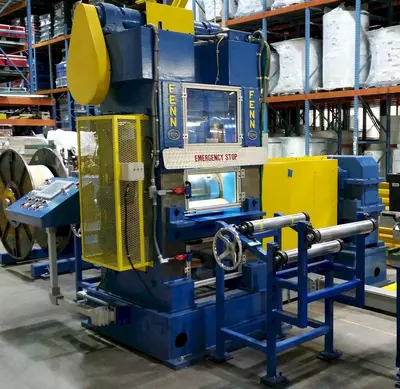
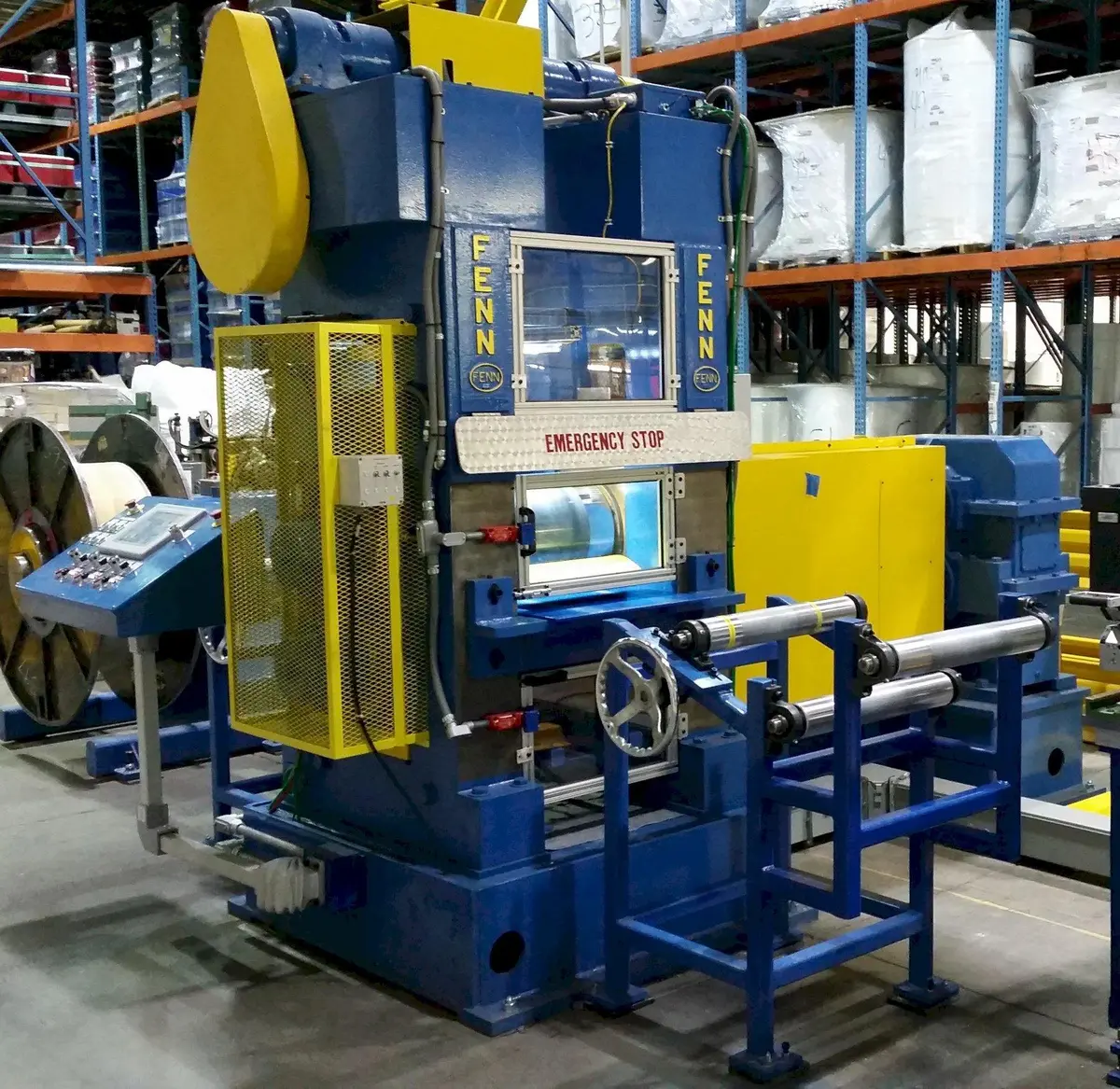
FENN MODEL 101 COMBINATION 2-HIGH / 4-HIGH HOT ROLLING MILL — IRM FACTORY REFURBISHED
The Fenn Model 101 is a heavy-duty combination hot rolling mill capable of performing both breakdown and precision finishing operations in a single stand. Configured for the hot rolling of specialty magnesium and other temperature-sensitive alloys from heavy incoming plank through thin finished sheet, the machine will be comprehensively refurbished and re-engineered by International Rolling Mills (IRM) for this application.
The combination configuration provides the roll-bite capacity and rigidity required for heavier early reductions together with the smaller work-roll geometry and control required for light, closely controlled finishing passes. This allows the rolling schedule to progress from incoming plank through breakdown and final finishing on a single mill stand, subject to the required reheating, intermediate cutting, and customer-provided material-handling steps.
2-HIGH / 4-HIGH COMBINATION CONFIGURATION
In the 2-High configuration, the mill utilizes nominal 10.500" diameter rolls for breakdown passes where the incoming stock is thick and heavier reductions are required.
When converted to the 4-High configuration, nominal 3.250" diameter work rolls are supported by the 10.500" diameter backup rolls, providing the smaller roll-bite geometry and support required for light, closely controlled finishing reductions where final thickness and surface condition are established.
Both configurations utilize a nominal 12.000" roll face, supporting both straight- and cross-rolled orientations and accommodating the required finished widths with suitable edge margin.
The Model 101 incorporates a rigid four-column housing with approximately 318 in² of total column cross-sectional area and an available separating-force capacity of approximately 550,000 lbf, providing the frame stiffness and load capacity required to support consistent rolling and gauge control across the roll face.
ROLL CONFIGURATION AND BEARING ARRANGEMENT
The 4-High finishing position will be equipped with new H13 hot-work tool-steel work rolls. H13 is selected primarily for its thermal stability and resistance to thermal fatigue and firecracking at elevated temperature rather than simply for hardness, particularly because the finishing work rolls directly contact the material and establish final gauge and surface condition.
The existing high-carbon chromium alloy 10.500" diameter rolls will be retained for the 2-High breakdown duty and will serve as backup rolls in the 4-High configuration. As part of the refurbishment, these rolls will be inspected, reconditioned as required, and reground to restore the required roll geometry and surface condition.
The thermal duty imposed on the large rolls during 2-High breakdown is comparatively manageable because the stock is substantially thicker, the number of breakdown passes is relatively limited, and the 10.500" diameter rolls have significantly greater thermal mass. Moderate preheating of these rolls further reduces the initial temperature differential when the hot magnesium enters the roll bite.
During 4-High finishing, the much smaller 3.250" diameter work rolls experience substantially more material-contact cycles as the strip becomes progressively longer through reduction, while their surface condition directly affects the finished sheet. For these reasons, H13 is applied specifically in the 4-High finishing position, where its hot-work properties provide the greatest benefit, while the existing high-carbon chromium alloy rolls remain well suited to the breakdown and backup duty.
The large 2-High/backup rolls utilize the Model 101's original precision needle-bearing assemblies. These substantial, specialized bearing assemblies will be thoroughly inspected and refurbished to factory specification as part of the rebuild. Retaining and rebuilding the original assemblies preserves the mill's proven heavy-duty bearing arrangement while avoiding the cost and complexity of converting the machine to an entirely different bronze-bearing system.
The new H13 4-High finishing work rolls will be supplied with new work-roll bearings and new work-roll bearing block assemblies.
INTEGRATED HEATED-ROLL SYSTEM
The mill will include an integrated heated-roll system for the nominal 10.500" diameter breakdown/backup rolls. These rolls will be bored to accept electric cartridge heaters and equipped with Watlow digital temperature controllers, Watlow DIN-A-MITE power controllers, and K-type thermocouples providing real-time roll-temperature measurement and closed-loop temperature control.
Because the magnesium is brought to and maintained at its required rolling temperature using the customer's separate furnaces, the rolls themselves do not need to operate at the alloy's full 300–450°C working temperature. The purpose of the roll-heating system is primarily to reduce the temperature differential between the hot material and the rolls, thereby reducing thermal shock, rather than to use the rolls as the primary heat source for the material.
For the proposed process, the breakdown/backup rolls are expected to operate primarily in approximately the 300–400°F (150–205°C) range.
In the 2-High configuration, the heated 10.500" diameter rolls contact the material directly. In the 4-High configuration, they function as heated backup rolls and transfer heat conductively to the H13 work rolls through continuous roll-to-roll contact, providing a degree of preheating and reducing the temperature differential the work rolls experience when contacting the hot strip.
The heating system will incorporate controlled temperature limits, with the maximum operating setpoint limited to approximately 450°F and overtemperature protection set at approximately 475°F. The additional margin allows for normal temperature overshoot as the rolls stabilize without nuisance trips while still providing protection against an excessive-temperature condition.
The controlled operating temperatures also limit unnecessary thermal exposure of the mill's precision needle-bearing assemblies. Required controls, electrical components, guarding, and safety features associated with the heated-roll system are included.
ROLL SURFACE FINISH
Final roll surface finish for both the new H13 4-High work rolls and the reconditioned high-carbon chromium breakdown/backup rolls will be selected during the refurbishment to suit the AP65 alloy and intended hot-rolling process, with the objective of promoting a clean rolled surface and reducing material pickup.
Lead-bearing magnesium alloys can be susceptible to adhesion at rolling temperature, and roll surface condition, material temperature, and lubrication can all influence material release and finished surface quality. Where beneficial and feasible, IRM can also evaluate an appropriate roll surface treatment to further improve release characteristics and wear resistance, subject to the roll material, roll size, available treatment capabilities, and intended rolling duty.
Lubrication and other process parameters will be developed by the customer as part of process development, with IRM working with the customer to establish the appropriate roll surface finish and, where feasible, any beneficial surface treatment for the intended application.
MAIN DRIVE AND CONTROLS
The mill will be powered by a new 100 HP inverter-duty AC main-drive motor and new variable frequency drive with closed-loop vector control, providing smooth operation, high starting torque, and stable low-speed performance across the anticipated rolling schedule.
The drivetrain ratio will be optimized as part of the rebuild to provide the appropriate combination of roll speed and available torque for both the 2-High breakdown and 4-High finishing operations. This allows the drive system to be properly matched to the actual rolling duty rather than carrying unnecessary installed horsepower.
All electrical controls will be new. The PLC and associated control components will be housed in a NEMA 12 electrical enclosure, and the main swing-arm operator station will include a touchscreen HMI and full operator controls.
Approximately 2-meter manual roller tables will be installed at the entry and exit of the mill to assist with handling the incoming plank and intermediate workpieces. Identified mill nip points will be mechanically guarded.
ELECTRO-MECHANICAL SCREWDOWN AND THICKNESS CONTROL
Roll gap will be controlled through a dual electro-mechanical screwdown system driven by two new 2 HP inverter-duty motors, with encoder feedback and closed-loop vector control.
The screwdowns can be operated simultaneously for overall roll-gap adjustment or independently for roll parallelism correction. Digital screw-position references for both sides of the mill will be displayed through the HMI, providing the operator with repeatable setup information and an indication of screw position at both ends of the roll.
This arrangement provides rapid centerline changes between the 2-High and 4-High configurations together with the fine adjustment capability required for finishing operations.
When used with the optional thickness measurement system described below, measured material thickness can be used by the operator to make controlled screwdown corrections between rolling passes. Because this application involves discrete-piece rolling with adjustments made between passes, the process is better suited to operator-directed correction based upon measured thickness than to conventional continuous-strip closed-loop automatic gauge control.
COMPREHENSIVE IRM FACTORY REFURBISHMENT
The Model 101 will undergo a comprehensive mechanical and electrical refurbishment at International Rolling Mills.
As part of the refurbishment, the machine will be fully disassembled, cleaned, inspected, and repainted. Mechanical components throughout the mill will be inspected and repaired, reconditioned, or replaced as required to restore the machine to factory specification.
The refurbishment will include:
Existing high-carbon chromium breakdown/backup rolls inspected, reconditioned, and reground
Large 2-High/backup-roll precision needle-bearing assemblies inspected and refurbished to factory specification
New H13 4-High finishing work rolls
New 4-High work-roll bearings and bearing block assemblies
New seals
New 100 HP inverter-duty AC main-drive motor and variable frequency drive
New screwdown motors and drives
New guarding
Integrated heated-roll system
Completely new electrical and control system, including new PLC, drives, electrical enclosure, touchscreen HMI, and operator controls
What is being retained is primarily the proven heavy-duty FENN Model 101 foundation—the rigid housing and major structural components that give the machine its strength, rigidity, and approximately 550,000-lbf separating-force capacity.
The result is not simply a used mill fitted with selected new components. It is a comprehensively rebuilt, like-new Model 101 restored and modernized specifically for this application, combining the proven heavy-duty FENN mechanical platform with new and reconditioned mechanical systems, a modern drive package, new controls, and application-specific hot-rolling equipment.
The completed machine will be supplied with the one-year limited warranty stated in this proposal.
AVAILABLE OPTIONAL FEATURES AND UPGRADES
THICKNESS MEASUREMENT GAUGE SYSTEM
A thickness measurement gauge system can be supplied as a separately priced option to provide repeatable thickness feedback during piece rolling.
Final gauge technology, measurement range, mounting arrangement, and system configuration will be selected after confirming the rolling sequence, material temperature and surface condition at the measurement point, required thickness range, width variation, and pass direction.
The system will provide measurement feedback for operator-directed screwdown corrections between passes and is not intended to function as conventional continuous-strip closed-loop automatic gauge control.
FACTORY ACCEPTANCE TEST (FAT) AND OPERATOR TRAINING
Following refurbishment, reassembly, and commissioning, IRM will conduct a Factory Acceptance Test (FAT) at our Pawtucket, Rhode Island facility with the customer's team prior to shipment.
The FAT will provide the customer's personnel with the opportunity to inspect the completed machine, witness its operation, verify its mechanical, electrical, drive, heating, control, and safety functionality, and receive hands-on operator and maintenance familiarization and training on the mill's functions and controls.
The FAT is intended to demonstrate the functionality and operation of the mill itself. It is not a demonstration or guarantee of finished-product performance for the customer's specific alloy or rolling process. IRM's facility is not equipped with the customer's controlled-atmosphere preheating furnaces or AP65 production feedstock, and the customer's rolling process, pass schedule, lubrication practice, and finished-product results will be developed and validated by the customer at its own facility as described under Process Responsibility.
Attendance at the FAT, including travel and accommodation for customer personnel, will be the customer's responsibility in accordance with IRM's standard terms. Successful completion of the FAT, or the customer's election not to attend after reasonable notice, will constitute acceptance of the mill with respect to matters reasonably discoverable during functional testing.
SCOPE OF SUPPLY, EXCLUSIONS, AND PROCESS RESPONSIBILITY
APPLICATION BASIS AND PROCESS RESPONSIBILITY
The proposed mill configuration is based on the customer's stated requirement to process preheated, extruded magnesium plank approximately 178 mm wide × 6.35 mm thick into finished sheet approximately 255 mm wide × 0.25–0.33 mm thick.
The mill will be configured with the mechanical, electrical, thermal, and control capabilities described in this proposal to support the intended application. However, actual processing results are dependent on the characteristics of the customer's alloy and the process developed by the customer, including material preparation, rolling temperature, temperature uniformity, reduction per pass, pass sequence, reheating frequency, straight or cross rolling, width development, material flatness, roll condition, lubrication, measurement method, and operator practices.
Development and validation of the rolling process, pass schedule, material-handling procedures, and finished-product requirements remain the customer's responsibility. IRM does not guarantee that a particular finished thickness, width, tolerance, surface condition, flatness, throughput, or material property will be achieved unless expressly stated in a separate written performance guarantee.
All process recommendations and technical estimates provided by IRM are offered for evaluation purposes and are subject to the Process Responsibility and Performance Disclaimer set forth in Section 12 of IRM's Standard Terms and Conditions.
MATERIAL PREHEATING AND REHEATING
Material preheating and reheating will be performed in separate customer-supplied furnaces. The mill's integrated heated-roll system is intended to control roll temperature and reduce the thermal differential between the hot workpiece and the rolls; it is not intended to replace the customer's material-heating furnaces or maintain the workpiece at its required rolling temperature throughout the complete rolling schedule.
Based on the total reduction from approximately 6.35 mm incoming thickness to 0.25–0.33 mm finished thickness, multiple reheating cycles should be anticipated throughout the pass schedule.
The controlled-atmosphere argon furnaces, inert-gas supply and purge system, furnace controls, and associated furnace material-handling equipment are outside IRM's scope of supply.
MATERIAL HANDLING
The mill is supplied with approximately 2-meter manual roller tables at the entry and exit for handling the incoming plank and intermediate workpieces.
As the material is reduced in thickness, its length will increase substantially. Depending on the incoming plank length and selected rolling sequence, the customer may need to cut the material between stages or make other provisions for handling and supporting the material throughout the process.
Any equipment or procedures required beyond the supplied entry and exit roller tables are the customer's responsibility.
REPRESENTATIVE IMAGES
Images shown in this proposal are representative of the machine. The actual mill may differ in appearance based on the final configuration, optional equipment, guarding, controls, and final build.
We use cookies to improve your experience. Privacy Policy.